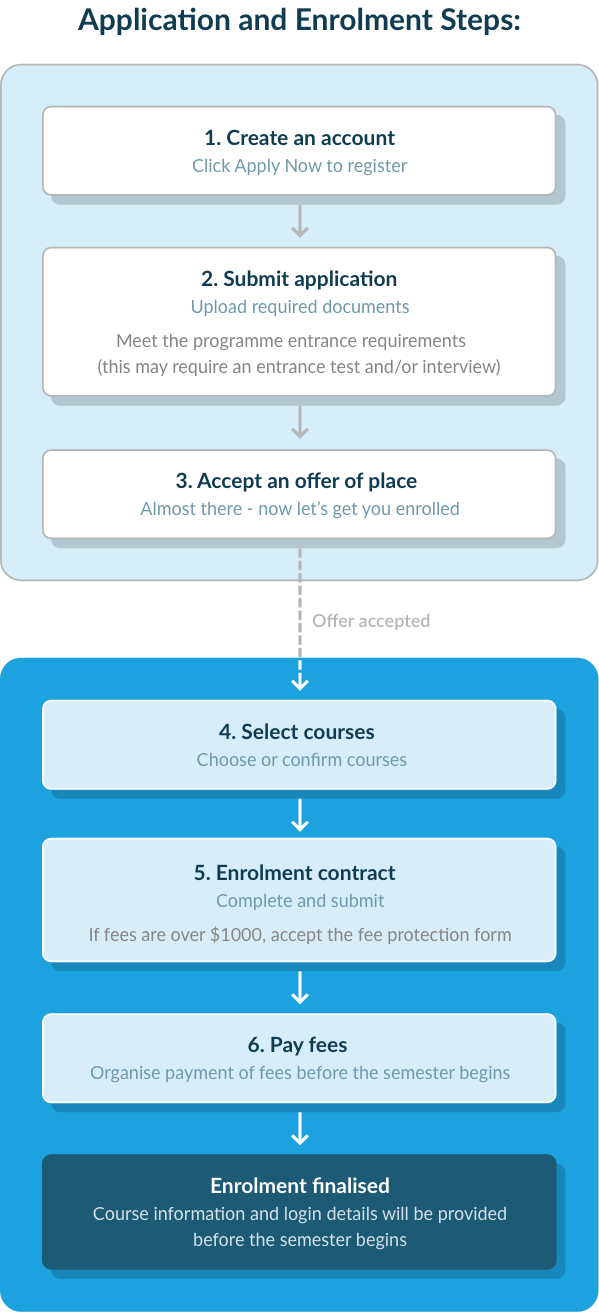

How to Apply and Enrol
1. Explore programme/course options via attending Info Night, becoming a Student for a Day, downloading information from our website or making contact with the Admissions Co-ordinator at the Campus you wish to study at.
2. Complete and return your application form (and Counselling supplement if necessary). Please ensure all sections are completed to prevent any delays and the following documents are attached:
- Certified copy of Passport or birth certificate
- Certified copy NCEA transcript (if under 20)
- Certified copy of highest educational achievement
- Essay on personal spiritual development
- IELTS Results (if applicable)
- Police Authorisation Form (for BCouns and BTch)
- CDL Course Selection Form (for Distance Learning)
- "Am I ready for Distance Learning?" Questionnaire (for Distance Learning)
3. Pay your Application Fee to Laidlaw College by the due dates listed on the provided CD or on the website.
Payment Options:
| In Person |
Cash, Credit, Cheque |
Onsite at Laidlaw College Finance Office |
|---|---|---|
| By Mail |
Cheque/Credit Card (on appropriate form) |
Post to Laidlaw College |
| Internet Banking |
Please include applicant’s name in the reference |
03-0155-0050416-00 (Westpac Henderson) |
4. Forward the Reference Form(s) to your nominated referee(s). You can download the forms from the CD provided or online on our website or request them from a Laidlaw campus.
N.B. Counselling applicants are required to provide two reference forms in total; one Pastoral Reference and one Professional Reference.
5. On receipt of your Application Form and Reference Form(s) you may be invited to the college for an interview. This interview may be waived in some circumstances, or conducted by phone. The Admissions Committee will then consider your application.
6. You will be sent a letter indicating the outcome of your application.
7. Apply at Studylink (www.studylink.govt.nz) for a student loan and/or student allowance (if applicable).
8. Complete the enrolment process.
9. Pay Fees.
10. Start studying…
Please Note: If you have any questions please contact the campus where you are applying.
Admission Requirements
Theology, Mission and Ministry | Education | Counselling | Centre for Academic Preparation and Support
Theology, Mission and Ministry
Every candidate must fulfil the requirements for entrance into a New Zealand University. These are as follows:
a. NCEA: a minimum of 42 credits at Level 3 or higher on the National Qualifications Framework (NQF). NQF credits can be gained either from unit standards or from achievement standards. The required number of credits must include a minimum of 14 credits at Level 3 or higher in each of two subjects from the approved subject list, with a further 14 credits at Level 3 or higher taken from no more than two additional approved subjects or domains on the NQF. In addition a minimum of 14 credits at Level 1 or higher in Mathematics on the NQF and a minimum of 4 credits in Reading and 4 credits in Writing at Level 2 or higher in English or Te Reo Maori are required. The Reading and Writing credits need to be selected from a schedule of approved achievement and unit standards.
b. Special Admission: A person who does not hold a university entrance qualification but who is a New Zealand citizen or permanent resident and is aged 20+ years on or before the first day of semester in which a proposed programme of study is offered is eligible to apply for Special Admission.
c. Students who completed high school overseas must hold qualifications deemed by the Laidlaw Admissions Committee to be equivalent to those detailed in section (a) above.
d. Students who do not have English as their first language: In addition to the requirements above, students in this category must fulfil English language requirements: an overall band of 6.5 or higher in IELTS (academic), with a minimum of 6.0 in writing.
A waiver for the IELTS may be granted:
- If the applicant has already received a degree with an appropriate grade from an appropriately accredited English speaking institution. If that institution is located outside New Zealand, Australia, the USA, the UK or Ireland, proof may be required that English was the medium of instruction.
- For long-term residents in New Zealand, or another English speaking country, who are able to demonstrate English language competency appropriate to the desired level of study.
Education
Every candidate for the degree must fulfil the requirements for entrance into a New Zealand University. These are as follows:
a. NCEA: a minimum of 42 credits at Level 3 or higher on the National Qualifications Framework (NQF). NQF credits can be gained either from unit standards or from achievement standards. The required number of credits must include a minimum of 14 credits at Level 3 or higher in each of two subjects from the approved subject list, with a further 14 credits at Level 3 or higher taken
from no more than two additional approved subjects or domains on the NQF. In addition a minimum of 14 credits at Level 1 or higher
in Mathematics on the NQF and a minimum of 4 credits in Reading and 4 credits in Writing at Level 2 or higher in English or Te Reo Maori are required. The Reading and Writing credits need to be selected from a schedule of approved achievement and unit standards.
b. Special Admission: A person who does not hold a university entrance qualification but who is a New Zealand citizen or permanent resident and is aged 20+ years on or before the first day of semester in which a proposed programme of study is offered is eligible to
apply for Special Admission.
c. Students who completed high school overseas must hold qualifications deemed by the Laidlaw Admissions Committee to be equivalent to those detailed in section (a) above.
d. Students who do not have English as their first language:
Applicants for the Bachelor of Teaching (Primary) and Worldview studies must have an IELTS (Academic) band score of 7.0 or more in each of the four components (listening, speaking, writing and reading) on entry to the programme.
A waiver for the IELTS may be granted:
- If the applicant has already received a degree with an appropriate grade from an appropriately accredited English speaking institution. If that institution is located outside New Zealand, Australia, the USA, the UK or Ireland, proof may be required that English was the medium of instruction.
- For long-term residents in New Zealand, or another English speaking country, who are able to demonstrate English language competency appropriate to the desired level of study.
e. Police Vetting: Applicants for the Bachelor of Teaching (Primary) and Worldview Studies will have their candidature confirmed on the receipt of a positive vet from the New Zealand Police.
Counselling
a. Every candidate for the degree must fulfil the following requirements: NCEA – a minimum of 42 credits at Level 3 or higher on the National Qualifications Framework (NQF). NQF credits can be gained either from unit standards or from achievement standards. The required number of credits must includea minimum of 14 credits at Level 3 or higher in eachof two subjects from the approved subject list, with a further two additional approved subjects or domains on the NQF. In addition a minimum of 14 credits at Level 1 or higher in Mathematics on the NQF and a minimum of 4 credits in Reading and 4 credits in Writing at Level 2 or higher in English or Te Reo Maori are required. The Reading and Writing credits need to be selected from a schedule of approved achievement and unit standards.
b. All candidates must be aged 20+ years on or before the first day of semester in which the proposed programme of study is offered.
c. Special Admission: A person who does not hold a university entrance qualification but who is a New Zealand citizen or permanent resident and is aged 20+ years on or before the first day of semester in which a proposed programme of study is offered is eligible to
apply for Special Admission.
d. Students who completed high school overseas must hold qualifications deemed by the Laidlaw Admissions Committee to be equivalent to those detailed in section (a) above.
e. Students who do not have English as their first language: In addition to the requirements above, students in this category must fulfil English language requirements: an overall band of 6.5 or higher in IELTS (academic), with a minimum of 6.0 in all bands.
A waiver for the IELTS may be granted:
- If the applicant has already received a degree with an appropriate grade from an appropriately accredited English speaking institution. If that institution is located outside New Zealand, Australia, the USA, the UK or Ireland, proof may be required that English was the medium of instruction.
- For long-term residents in New Zealand, or another English speaking country, who are able to demonstrate English language competency appropriate to the desired level of study.
f. Police Clearance: It is a condition of enrolment that students submit a police clearance, the cost of which is the responsibility of the student.
Application and Selection Procedures
Year One
Candidates should request an application form for entry into the BCouns and have submitted this no later than November 15 for entry into the programme in the following year. As part of the application process, candidates will be required to arrange for two referees to complete confidential Referee Forms, and candidates shall also be required to supply the contact details for one additional referee who may be contacted if deemed necessary. These forms must accompany the completed application.
All candidates who have successfully completed the first stage of the application process will be expected to attend a group interview, and, if required, a further interview by a panel of two selectors. Applicants will be notified of the outcome of their application by December 20.
During this interview the candidate will be assessed on their ability to successfully complete academic studies at this level and any relevant training or experience in communication skills. Candidates must demonstrate a willingness to learn and receive personal feedback in a non-defensive way, and a personal maturity appropriate for someone involved in a people-helping role. They must demonstrate a level of self-awareness and critical self-reflection appropriate for someone beginning a counselling training programme.
They must also demonstrate relational maturity and a commitment to wrestling with core issues of the Christian faith. Year one candidates will not need access to a client base.
A background knowledge and understanding of the “story” of Scripture is required. Satisfactory completion of a Laidlaw College certificate, diploma or degree, or an equivalent, would be an advantage (see Recognition of Prior Learning information in General Information and Regulations section).
Students must commit to undertaking 10 hours of personal counselling, with a practitioner of their choice, in their first year of study, and to demonstrate that they have completed these before they transition into Year Two. They must undertake a further 10 hours of personal counselling throughout Years Two and Three. The cost of personal counselling is the responsibility of the student.
Year Two
In order to complete Year One and successfully transition into Year Two of the programme, a student will be required to satisfactorily fulfil the following criteria:
- Completion of all Year One requirements, including 10 hours of personal counselling. It is compulsory to complete at least 75 credits of counselling theory and practice courses (which must include Foundations of Relational Practice A & B), and 45 credits of theology (which must include God’s Triunity and Human Relationality).
- Assessment in an interview by a selection panel of at least two, as being capable of successfully completing all components of the programme.
- Current or potential access to clients. Practicum placement forms an integral part of the Year Two and Year Three programme. Students will be required to complete a minimum of 200 hours of supervised counselling.
- Current or potential access to a supervisor who meets the requirements as outlined in the Practice Manual.
- Students must be able to demonstrate during their assessment interview that they have been developing in areas of personal growth, including the following:
- Communication skills
- Willingness to learn and receive personal feedback in a non-defensive manner
- Attitudes of empathy, positive regard and genuineness
- Integrated personal maturity appropriate for someone involved with clients
- Ability to challenge clients within the context of a caring and respectful relationship
- Respect for individual gender, socio-economic and ethnic differences.
- Applicants for the full-time, one semester programme (Stream 1) require an overall IELTS band (academic) of 5.5with a minimum of 5.0 in reading and writing.
- Applicants for the full-time, full-year programme (Stream 2) require an overall IELTS band (academic) of 5.0 with a minimum of 4 in writing and 4.5 in reading.
- For long-term residents in New Zealand, or another English speaking country, who are able to demonstrate English language competency appropriate to the desired level of study.
Year Three
Entry into Year Three is based on successful completion of learning requirements for Year Two. This includes ongoing personal counselling. Students must also meet the following criteria:
Completion of Relational Theories and Practice (A & B) and Professional Practice (A & B), plus a further 30 credits of
counselling theory and practice courses and completion of 15 credits of theology.
DipCouns graduates bridging to the BCouns
In order to enrol in the bridging programme from the DipCouns to the BCouns candidates are required to satisfactorily demonstrate the following:
A high level of competency in the core skills. Applicants must submit a video recording of a live counselling session to demonstrate their skill level. Applicants must demonstrate competent professional practice commensurate with the learning outcomes of Professional Practice B.
A current placement for Practicum (B) that meets the requirements as outlined in the Practicum Manual.
Centre for Academic Preparation and Support
There are no formal admission requirements for students who are native speakers of English, or are long-term residents of New Zealand or another English speaking country, who are able to demonstrate English language competency appropriate to the desired level of study.
For students not meeting the above requirements:
A waiver for the IELTS may be granted:
Further information
For more information, please refer to the Academic Calendar on our website.